Streaming TV Advertising: How It Works and How to Run It

Streaming TV advertising means buying video ads that play inside streaming apps and on connected TV devices, targeted to households instead of to a time slot. For an established eCommerce or lead generation brand, it is a way to get TV-sized reach with digital-style targeting and reporting. It works best when you treat it as a performance channel with a clear profit target, not as a branding experiment.
This guide covers what streaming TV advertising is, how an ad gets from your account to a living room screen, how to buy and target it, how to launch a first campaign, and how to measure whether it paid for itself.
TL;DR
- Streaming TV ads are sold digitally and shown in streaming apps on TV screens. Connected TV (CTV) is the screen, and OTT is the delivery method.
- Per the Coalition for Innovative Media Measurement, nearly 70% of the US population uses CTV platforms, and the channel is now mainstream.
- Start broad, with geography-first targeting, then narrow once you have data. Build creative for a big screen with one clear action.
- Measure beyond impressions: use conversion tracking, several attribution methods and incrementality tests, and check that your ads reach real viewers.
- Decide what a profitable result looks like before you spend, then size the budget to that target.
Table of Contents
- What streaming TV advertising actually is
- How streaming TV ads work
- How you can buy streaming TV ads
- Planning your first streaming TV campaign
- Measuring streaming TV ad performance
- Where streaming TV fits next to Meta and Google
- Common mistakes to avoid
- Our perspective
- Work with a team that manages streaming TV for profit
- FAQ
- Sources
What streaming TV advertising actually is
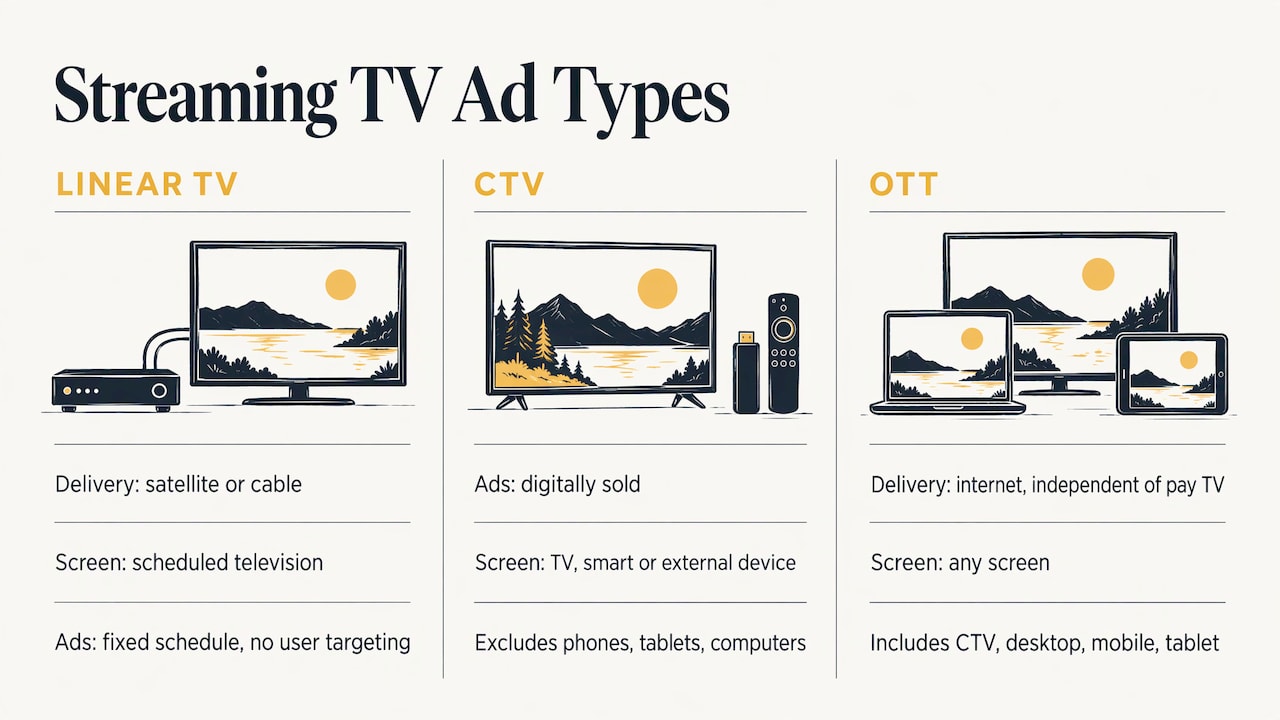
Three terms get used as if they were the same thing. They are related, but they are not identical.
Linear TV is scheduled television delivered by satellite or cable. According to eMarketer, its ads run on a fixed schedule without user-level targeting.
Connected TV (CTV) refers to digitally sold ads that appear on TV screens, through smart TVs or external devices such as streaming sticks and gaming consoles. eMarketer notes that it does not include ads on phones, tablets or computers.
OTT (over-the-top) describes video delivered over the internet independently of traditional pay TV, on any screen. Nielsen puts the distinction simply: CTV is about the screen, and OTT is about the delivery method. So OTT includes CTV plus streaming on desktop, mobile and tablet.
When people search for “streaming TV advertising,” “connected TV advertising” or “OTT advertising,” they usually want the same thing: a way to put video ads in front of people who have stopped watching cable. In practice, for most advertisers, the buying process is the same.
Where the ads run
Streaming TV inventory falls into a few buckets:
- Subscription services with ad tiers, where ads appear on a cheaper, ad-supported plan.
- Virtual pay-TV services (vMVPDs), which stream live channels over the internet. eMarketer reports that YouTube TV leads this category with 21.5 million US viewers, followed by Hulu + Live TV and Sling TV.
- Free ad-supported streaming TV (FAST), which eMarketer says is led by Pluto TV, The Roku Channel, Tubi and Amazon Freevee.
- Device and smart-TV layers, such as home-screen placements.
The practical point: you rarely buy each of these one by one. Most brands reach them through a platform that bundles inventory from many apps and publishers.
How streaming TV ads work
Behind the scenes, a streaming ad follows a quick sequence. A viewer starts a show or channel. The app signals that an ad break is coming. An ad is selected, either through an auction in milliseconds or through a pre-arranged deal. The ad is inserted into the break and played. The impression is then recorded so that frequency can be capped and results can be reported.
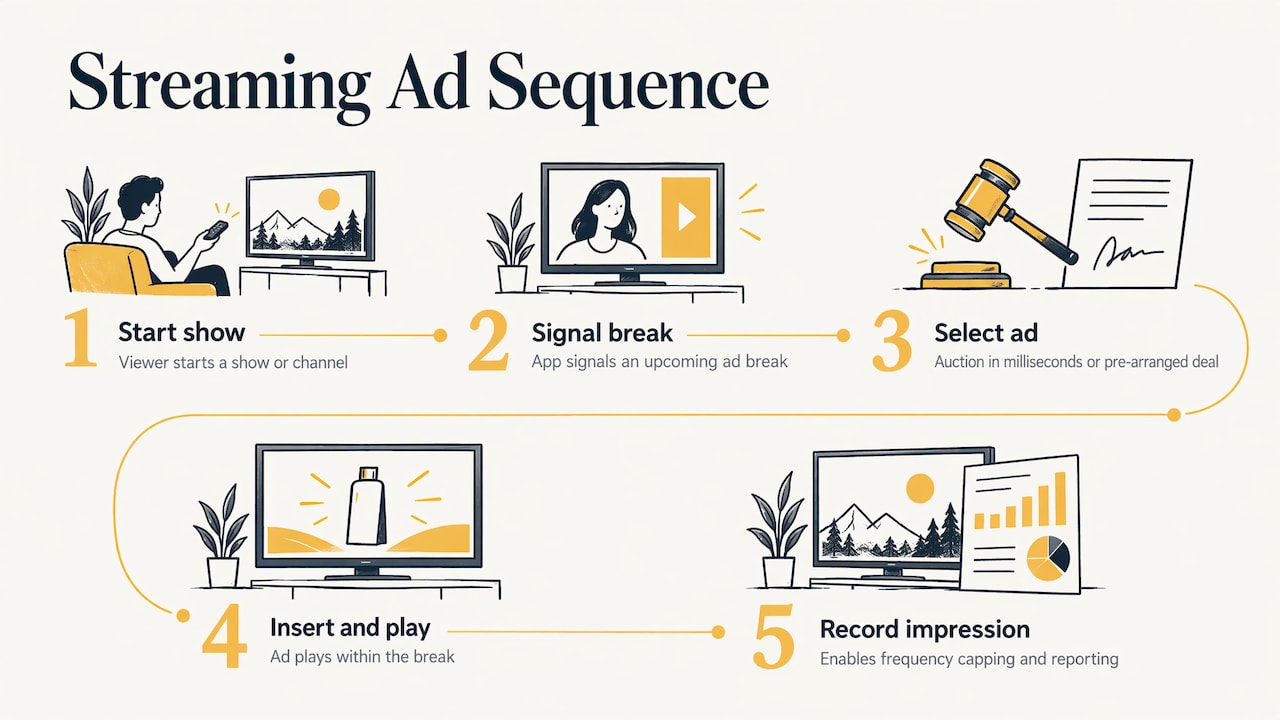
That last step is where streaming differs most from broadcast. The CIMM guide explains that because CTV is IP-delivered and fully digital, it can produce impression-level data: who saw what, when, and on which device. It also supports near-real-time reporting, and measurement that can be consistent with other internet-connected channels.
The same guide points out a benefit for smaller advertisers. Brands that could never afford a national broadcast campaign can now reach premium national inventory. For a brand doing $25,000 or more a month in revenue and looking for its next scalable channel, that matters.
Why targeting is different from social and search
Streaming TV is not a cookie-based channel. Nielsen notes that individual user tracking is uncommon on CTV, which has pushed the industry to rely on aggregated household data and contextual clues. That limits some targeting, but it also leaves CTV in good shape for a world without cookies. And because TV screens are large, they create an environment where groups watch together, not just individuals.
For you, that means targeting works at the household and audience-segment level. You are not retargeting a single browser session the way you would on search or social.
How you can buy streaming TV ads
The CIMM guide describes a fragmented ecosystem with four main sales channels:
| Buying route | How it works | Best for |
|---|---|---|
| Direct buys | You negotiate with a publisher or streamer | Specific premium placements |
| Programmatic guaranteed | Automated purchase of reserved inventory | Predictable delivery at scale |
| Private marketplaces | Invitation-only auctions with selected publishers | Quality control with some efficiency |
| Open exchanges | Open auctions across many publishers | Reach and cost flexibility |
Each has trade-offs among premium inventory access, automation efficiency, audience scale and cost. The guide recommends picking the buying channel based on the KPIs of each campaign, not by habit.
It also lists eight best practices that are worth adopting even if you never read the full document:
- Standardize cross-functional collaboration.
- Consider CTV’s creative capabilities early.
- Apply a zero-based budget approach.
- Optimize buying channels for campaign-specific KPIs.
- Guard investments with verification.
- Use high-fidelity audience identity sources.
- Engineer access to your data.
- Use multiple attribution methods.
The zero-based budget idea is the one performance marketers should like most: justify every dollar from the outcome you need, not from last quarter’s spend.
Planning your first streaming TV campaign
A first campaign should be built to teach you something while still being accountable to profit. Here is the sequence we use as a framework.
1. Set the target before the budget
Work backward from margin. Know your average order value or lead value, your gross margin, and the cost per acquisition you can afford. Then decide what you expect streaming TV to do: drive direct conversions, lift branded search and direct traffic, or feed your retargeting pools on Meta and Google. Write it down as a number, not a hope.
2. Size the budget to learn
Streaming TV needs enough impressions to reach the same households more than once and to give you statistically useful results. Too little spend gives you noise. If you want a walkthrough, our guide on how to set a streaming TV ad budget on Vibe covers the budgeting decisions step by step.
3. Start broad on targeting
Geography-first targeting is a sensible start. Layering age, income, interests and other filters too early shrinks the audience and can raise your costs before you know who actually converts. Once you have conversion data, tighten the audience around the households that bought.
4. Build creative for the big screen
CTV creative is not a repurposed social clip. Viewers are on a couch, often with the sound on, and the ad is full screen. Some practical rules:
- Lead with your brand and your offer within the first few seconds.
- Use a single, clear call to action. A short, memorable URL works. A QR code can work too, since the viewer has a phone within reach.
- Make the ad understandable without needing to click.
- Design for 15- and 30-second spots so you can test both.
The CIMM guide advises thinking about creative early, rather than at the end of the planning process, because the format shapes what you can do.
5. Set up measurement before launch
Decide how you will track conversions, which attribution methods you will compare, and how long the test will run. Build the tracking before the first impression goes out, not after. If you need the mechanics of getting a campaign live, see how to create a streaming TV campaign on Vibe, and browse the full set of streaming TV ads guides.
6. Run long enough to learn
Streaming TV works through repeated exposure. Give the campaign enough time to reach households, engage them and reach them again before you judge it. Cutting a campaign after a few days tells you almost nothing.
Measuring streaming TV ad performance
Measurement is where streaming TV earns its place in a performance mix, and where careless buyers get burned.
Metrics worth watching
Impressions and reach tell you whether the campaign delivered. They do not tell you whether it was profitable. Build a measurement stack in layers:
- Delivery: impressions, reach, frequency, and video completion rate.
- Response: branded search volume, direct and organic traffic, site visits from the ad’s URL or QR code.
- Outcomes: conversions, revenue or qualified leads, and cost per acquisition against your margin target.
- Incrementality: how many conversions happened because of the ads, compared with a group that did not see them.
Completion rate and similar engagement figures are useful for comparing creative against creative within your own account. Treat published industry averages with caution unless they come from a source you trust and a time period that matches yours.
Check that your ads reach real viewers
Verification matters. A GroupM and iSpot study reported by Next TV found that 8% to 10% of CTV ad impressions were counted as delivered while the TV was off, which amounted to about $1 billion in waste. The overcounting was heavier on devices such as dongles, gaming consoles and sticks, at 17%, while native smart-TV apps, which account for about half of all CTV viewing, showed virtually no overcounts. The study dates from 2022, so treat it as a reason to ask about verification and not as a current rate. It is one reason the CIMM guide lists “guarding investments with verification” among its best practices.
Use more than one attribution method
No single attribution model gives the full picture for a channel that works partly through awareness. A reasonable approach:
- Track direct response through the campaign URL or QR code.
- Compare lift in branded search and direct traffic in the markets and weeks where ads ran.
- Run a geographic holdout test: hold back certain regions and compare their results with the exposed regions.
- Cross-check against your overall blended results, such as total revenue and marketing efficiency ratio, not just platform-reported conversions.
This is the point of the CIMM recommendation to use multiple attribution methods. When they point in the same direction, you can scale with confidence.
Where streaming TV fits next to Meta and Google
Streaming TV rarely replaces your existing channels. It tends to work as an upper-funnel layer that makes the rest of your paid media more efficient. A household that sees your ad on the living-room screen may search for your brand later, or click a Meta retargeting ad on their phone.
That means the channel should be judged in the context of the whole account. If branded search grows and your blended acquisition cost holds steady or improves during a streaming flight, the channel is doing its job, even if last-click reports give it little credit. If you are not sure your current spend is clean enough to add a new channel, start with the basics: our paid ads fundamentals cover metrics, tracking and budgets.
Common mistakes to avoid
- Launching without a profit target. Reach is easy to buy. Profit is the goal.
- Over-segmenting at the start. Narrow targeting on a small budget starves the campaign of scale.
- Reusing vertical social video. Creative that was designed for a phone feed looks wrong on a TV.
- Judging too early. A week is not a test.
- Trusting platform numbers alone. Compare them with your own blended data and holdouts.
- Ignoring the landing experience. A viewer who types your URL or scans a code needs a fast page that matches the ad. If you are unsure how yours performs, try the free CRO grader.
Our perspective
Most advertisers talk about streaming TV as a reach play. We look at it as a margin question. The channel has become mainstream, so the real question is not whether your customers are watching but whether a dollar spent there returns more than a dollar of profit.
That is why we start with the economics: your margins, your allowable cost per acquisition and your current blended results. Then we plan the test around them, with measurement in place before any spend goes out. Mitch Lawrence, a Harvard-trained economist, leads the agency, and our clients work directly with senior-level people, not a handoff to a junior team.
We manage more than $100,000 in daily ad spend across channels, and streaming TV is one of the channels we manage alongside Meta, Google and others. Having them under one roof means we can judge streaming against your other channels using one set of numbers.
Our approach is designed to maximize profit, not activity. In a channel where it is easy to buy impressions, that discipline is what separates a campaign that scales from one that only looks busy.
the author
Work with a team that manages streaming TV for profit
If you run an established eCommerce or lead generation brand and want to add streaming TV to a paid media mix, we can plan, launch and manage it with you. Our team handles strategy, creative development, campaign management, tracking and scaling, with senior-level attention on your account.
See every platform we manage on our ad channels page. If you want an outside look at your current spend first, our ad account audit and ad spend leak audit are a good starting point. You can also start from our homepage to learn how we work.
FAQ
What is the difference between streaming TV, CTV and OTT advertising?
Streaming TV advertising is the everyday name for video ads sold digitally inside streaming content. CTV refers to the TV screen, including smart TVs and connected devices. OTT refers to the delivery method, internet video on any device, so it includes CTV plus phones, tablets and computers, as Nielsen explains.
How are streaming TV ads different from traditional TV ads?
Linear TV ads run on a fixed schedule without user-level targeting. Streaming TV ads are sold digitally, can be targeted to audiences and geographies, and produce impression-level reporting. That is what lets you tie spend to results in a way broadcast never could.
How should I measure streaming TV ad performance?
Use layers. Look at delivery metrics, then response signals such as branded search and direct traffic, then conversions against your margin target. Add a geographic holdout test to estimate incremental impact, and compare several attribution methods instead of relying on one.
How much should I spend on a first streaming TV campaign?
Enough to reach households repeatedly and produce readable results over a sensible run time. Work backward from your target cost per acquisition and the conversions you need to learn from. Our streaming TV budget guide walks through the steps.
Do I need an agency to advertise on streaming TV?
Not strictly, since self-serve routes exist. But planning, creative, verification and attribution all take experience, and mistakes on a new channel can be costly. Brands that want senior-level management and profit-focused measurement often hand it to a specialist team.
Sources
- Coalition for Innovative Media Measurement: Best Practices for Planning, Buying and Measuring CTV Ad Campaigns (July 2025)
- eMarketer: FAQ on converged TV, linear and connected TV landscape (January 2026)
- Nielsen: What’s the difference between OTT, CTV and streaming (February 2024)
- Next TV: GroupM, iSpot study finds $1 billion in CTV ads being counted when TV is off (June 2022)