
How Much Should You Spend on Google Ads in 2026?

Spend what your numbers can prove, not what a benchmark says. For most established U.S. businesses that lands between $5,000 and $50,000 a month. Small businesses often start at $500 to $5,000. The right figure for you comes from three inputs: how many customers or leads you want, what a click costs in your market, and how much profit each sale leaves after costs. This guide shows you how to work it out.
TL;DR
- Search Engine Land reports typical monthly spend of $500 to $5,000 for small businesses, $5,000 to $50,000 for mid-size businesses and $25,000 to $100,000+ for large ones.
- Build your budget backward: target conversions, divided by conversion rate, times cost per click.
- Know your break-even ROAS (1 divided by your profit margin) before you set a number.
- Raise spend 10% to 20% at a time when results are good. When they are weak, fix the campaign first.
Table of Contents
- What Google Ads actually charges you
- Typical Google Ads budgets by business size
- What clicks cost in the U.S.
- Build your budget from your goal
- Know your break-even point first
- How to scale your spend without breaking it
- Where budget quietly leaks
- Our perspective
- Get a budget built on your own numbers
- FAQ
- Sources
What Google Ads actually charges you
Google Ads has no flat fee or monthly subscription. Google’s own pricing guide explains that Search ads charge per click, and you control cost by setting an average daily budget. That means the question “how much should I spend” is really “how much am I willing to pay for the clicks that turn into profit.”
Two mechanics matter when you pick a number.
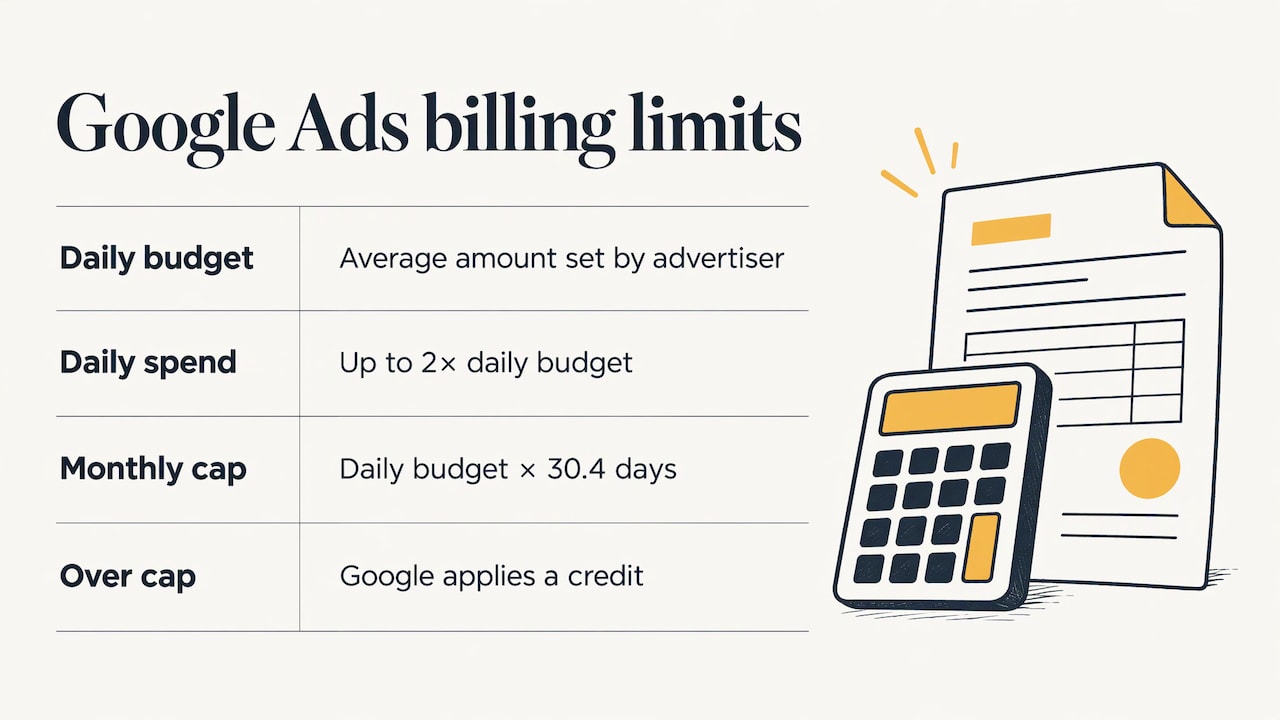
Daily spend can run above your daily budget. According to Google Ads Help, actual daily spend can reach up to twice the average daily budget on a given day. Your monthly charge is capped at the average daily budget multiplied by 30.4 days, and Google applies a credit if you go over. Plan a monthly figure, divide by 30.4 and expect daily swings.
You pay for an auction, not a rate card. Google’s guide says Ad Rank is based on your bid, ad quality (Quality Score) and ad assets. Relevant, high-quality ads can pay less to win than weaker competitors. Two businesses with the same budget can get very different click volume.
Typical Google Ads budgets by business size
Benchmarks are a sanity check, not a plan. Here is where U.S. businesses tend to sit, per Search Engine Land’s guide (last updated October 27, 2026).
| Business size | Typical monthly spend |
|---|---|
| Small business | $500 to $5,000 |
| Mid-size business | $5,000 to $50,000 |
| Large business | $25,000 to $100,000+ |
The same guide notes that small-budget accounts can struggle, because less investment means a slower learning curve. Fewer clicks means less data, and less data means slower decisions about what works.
If you already do $25,000 or more in monthly revenue, you are past the “test with a few hundred dollars” stage. Your question is not the minimum. It is how much you can spend before the next dollar stops paying for itself.
What clicks cost in the U.S.
Cost per click (CPC) is the biggest swing factor in your budget. Benchmarks from a 2026 analysis of 13,474 U.S. search campaigns (April 2025 to March 2026, Google and Microsoft Ads combined, drawn from WordStream/LocaliQ data) show:
- Median CPC across all industries: $5.42
- Median click-through rate: 6.64%
- Median conversion rate: 8.18%
- Median cost per lead: $66.69
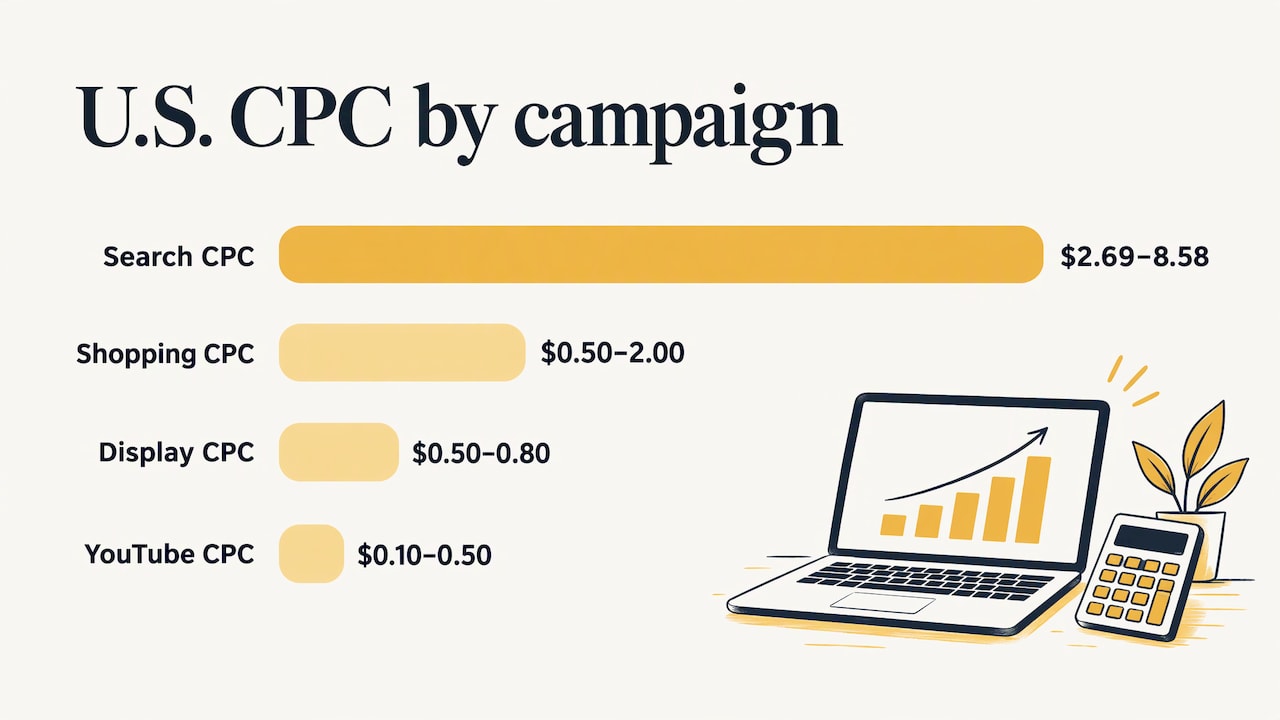
Campaign type changes the picture. AdsPreview’s U.S. guide puts Search at roughly $2.69 to $8.58 CPC with a 7.52% conversion rate, and Shopping at $0.50 to $2.00 CPC with a 2.81% conversion rate. Display and YouTube video clicks are far cheaper, at $0.50 to $0.80 and $0.10 to $0.50, but they serve a different job, usually earlier in the buying decision.
Location matters too. The same guide says a plumber in Manhattan pays three to four times more per click than one in a small market. National medians are only medians.
Treat all of these as starting assumptions. Your own account data replaces them within a couple of months.
Build your budget from your goal
This is the method we trust over any benchmark. Start with the outcome, then price it.
Budget = target conversions ÷ conversion rate × cost per click
Worked example: a lead generation business
Say you want 30 qualified leads a month. Use the benchmark assumptions of an 8.18% conversion rate and a $5.42 CPC. Your own numbers will differ.
- 30 leads ÷ 0.0818 = about 367 clicks needed
- 367 clicks × $5.42 = about $1,988 a month
That is roughly $65 a day. Now check it against value. If one lead in five becomes a customer worth $2,000 in gross profit, each lead is worth about $400. A $66 lead is a strong trade. If a customer is worth $150, it is not.
Worked example: an eCommerce brand
Say you sell a product with an $80 average order value and a 40% margin after product cost, shipping and fees, before ad spend. Your break-even ROAS is 1 ÷ 0.40 = 2.5. You want 200 orders a month through Shopping campaigns, and you assume a 2.81% conversion rate and a $1.25 CPC (an illustration within the range above).
- 200 orders ÷ 0.0281 = about 7,117 clicks
- 7,117 × $1.25 = about $8,900 a month
- Revenue: 200 × $80 = $16,000, so ROAS is about 1.8
That is below the 2.5 break-even. The budget formula is not the problem. The inputs are. To make this profitable you need a higher conversion rate, a higher order value, a cheaper click or a better margin. This is why you run the math before you commit spend, and why a budget number alone tells you very little.
Our Google Ads budget guide walks through the setup side in more detail.
Know your break-even point first
ROAS (revenue divided by ad spend) is the number most dashboards show, but it ignores margin. InsightIQ’s 2026 benchmarks give the rule: break-even ROAS equals 1 divided by net profit margin. A 25% margin means a 4.0 break-even. The same source lists typical e-commerce ranges:
| Campaign type | Typical ROAS range |
|---|---|
| Brand Search | 8.0 to 12.0 |
| Non-Brand Search | 3.5 to 5.5 |
| Shopping | 3.5 to 5.0 |
| Performance Max | 4.0 to 5.8 |
A healthy-looking ROAS can still lose money. A Shopify profitability breakdown shows how a campaign at 4.5x ROAS can lose money when it pushes low-margin inventory at a discount. Its approach is to subtract cost of goods, discounts, refunds, payment and fulfillment costs and ad spend from matched revenue, campaign by campaign.
For lead generation, the same logic applies with different inputs: close rate, average customer value and the cost to serve.
Three numbers to write down before you spend
- Contribution margin per order or per customer, after every variable cost except ads.
- Break-even cost per acquisition, which equals that margin.
- Target cost per acquisition, a figure below break-even that leaves the profit you want.
Your budget is whatever lets you buy as many acquisitions as the market will sell you at or below the target.
How to scale your spend without breaking it
Search Engine Land advises raising your monthly budget by 10% to 20% when the numbers look good. When performance is weak, it recommends reviewing targeting, ad copy and landing page instead of adding money.
In practice, we apply this as a loop:
- Hold the budget steady until the campaign has enough conversions to judge.
- Compare cost per acquisition with your target, using a 90-day view, not a single week. Fibbler’s benchmark guide makes the same point: one month’s CPC says little, and rising CPC with falling cost per lead is a good result.
- If you are under target, raise spend 10% to 20% and wait for the data to settle.
- If you are over target, fix the conversion path (offer, landing page, tracking) before spending more.
- Benchmark yourself against your own category. A B2B account should not be judged against all-industry click-through rates.
The ceiling arrives when each extra dollar buys customers at a cost above your target. That is your budget limit, and it moves as your margin, creative and site improve.
Where budget quietly leaks
Most accounts we look at do not have a budget problem. They have a leak problem. Common places money disappears:
- Broad targeting that matches searches with no buying intent
- Brand and non-brand campaigns reported together, so strong brand ROAS hides weak prospecting
- Conversion tracking that counts the wrong events, so Google optimizes toward the wrong people
- Landing pages that were built for traffic, not for the offer
- Discounted, low-margin products driving most of the spend
Fixing these often does more than raising the budget. It is also why we start many engagements with an audit rather than a bigger spend.
Our perspective
Most budget advice starts with a benchmark and ends with a number. We start with profit.
We manage over $100,000 in daily ad spend, and the pattern is consistent: brands that ask “how much should we spend” get a better answer from “how much profit does a customer leave us.” Spend is an output of margin, conversion rate and what the auction charges, not an input you pick from a table.
Our approach is built to maximize profit, not activity. That means we model break-even and target acquisition cost before launch, track revenue against real orders or closed leads, and scale in controlled steps. Because senior-level people stay hands-on in your account, those decisions are made by someone who knows your margins, not handed to a template.
If your account is spending well and still not growing, the answer is rarely just more money. It is usually cleaner tracking, a stronger offer and campaigns structured around the products or services that carry margin.
the author
Get a budget built on your own numbers
If you are an established eCommerce or lead generation brand doing $25,000 or more in monthly revenue, we can help you turn this math into a plan. We run Google Ads alongside Meta and other channels, and we start from your margin and your tracking. You can see the channels we manage on our paid media channels page.
Already spending and unsure where the money goes? Our ad account and ad spend leak audits look at structure, tracking and wasted spend so your next budget decision rests on real data. For more setup detail, browse our Google Ads guides, including how to create a Google Ads campaign.
FAQ
What is a good starting budget for Google Ads?
For a small business, Search Engine Land puts typical spend at $500 to $5,000 a month. Mid-size businesses typically spend $5,000 to $50,000. Pick the point in that range your break-even math supports, and make sure it is big enough to produce enough clicks to learn from.
Does Google charge for ads if nobody clicks?
On Search campaigns, Google charges per click, and there are no flat fees or monthly subscriptions, according to Google’s pricing guide. You set an average daily budget to control cost. Some other campaign types and bidding strategies can charge differently, so check how your chosen campaign bills.
Can Google spend more than my daily budget?
Yes, on a given day. Google Ads Help says daily spend can reach up to twice your average daily budget. Your monthly charges will not exceed the average daily budget times 30.4 days, and a credit is applied if they do.
How do I know if my Google Ads spend is profitable?
Compare your return with break-even ROAS, which is 1 divided by your net profit margin. At a 25% margin you need at least 4.0 just to break even. Then check revenue against real orders or closed leads, not platform-reported conversions alone.
When should I increase my Google Ads budget?
When cost per acquisition is at or below your target over a meaningful window, such as 90 days. Raise the budget 10% to 20% at a time, as Search Engine Land suggests. If results are weak, review targeting, ad copy and the landing page first.
Sources
- How much does Google Ads cost? (Search Engine Land)
- How much does Google Ads cost? (Google Ads)
- Manage your spend in Google Ads (Google Ads Help)
- Google Ads Benchmarks 2026 (Fibbler)
- Google Ads Cost Per Click by Industry (AdsPreview)
- 2026 E-Commerce ROAS Benchmarks (InsightIQ)
- Google Ads + Shopify: Real Campaign Profitability (Daymark)